Monday, July 23, 2012

CURRENT PROJECT: "Joy" Page 1

I recently completed an illustration for a lovely story, titled "Joy, about adoption and the special bond between families.  I am working closely with the author, Susan Longley, to create a series of 12 illustrations to help bring her story to life as an illustrated e-book app.

 Here is a sneak peek at the first page of the children's e-book, "Joy":


Visit this link to the author's website for more information about this e-book, to learn about the author's personal experiences that inspired her to write this story, and to pre-order your own copy of "Joy."

Can't wait to share more with you all soon!

Thursday, June 28, 2012

NEW PROJECT: Adoption E-Book- "Joy"

I am pleased to announce that I have started working on illustrations for an e-book project with author Susan Longley.

The book, titled "Joy," is a story about adoption that has a great message, described by the author as being "about the spiritual connection between adopted children and their forever family." Since the author is self-publishing, she has started a campaign to help raise money to fund this project so she can move forward spreading the wonderful message of this book.

Visit this link for more information about this book and how you can contribute to the campaign.

I can't wait to share these illustrations with you all soon!

Sunday, June 24, 2012

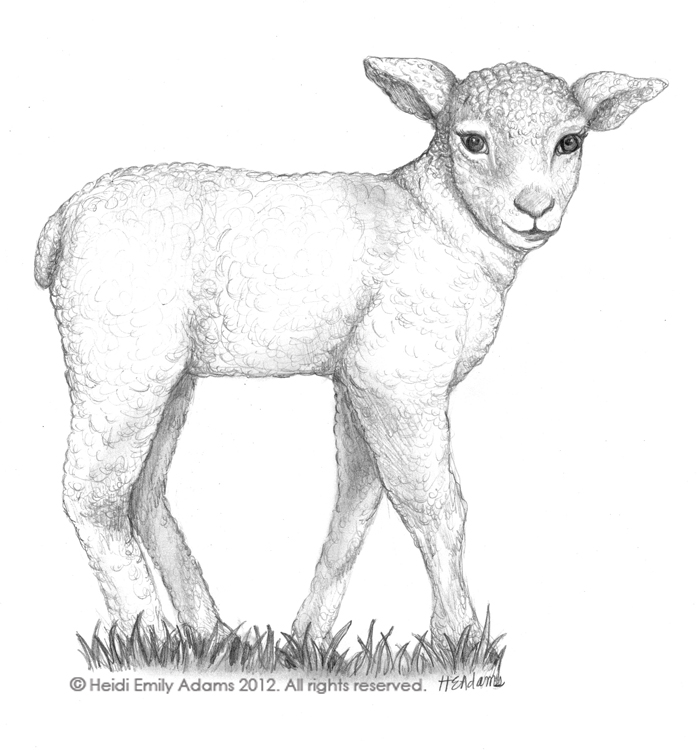
A Little Lamb and a Lesson in Animal Ages

Every Sunday, I have the great blessing of teaching a class of five- and six-year-olds at my church. Today, our lesson was about how Jesus Christ is the Good Shepherd, so I decided to draw a picture of a cute little lamb for the kids to take home with them to help them remember what they learned at church today. I sure love those cute little lambs I get to teach every week!

Lesson Learned: When drawing baby animals, be aware of proportions. Make sure you have accurate reference of the baby animal or your illustration may end up looking more like a miniature animal than a baby animal.  Just like human babies, baby animals have a very different head-to-body size ratio. To keep your baby animal characters looking young, make the head bigger, eyes and ears larger and torso shorter than those of a grown animal. For sheep and other hoofed animals, make the legs skinnier and the coat shorter and softer looking than that of its adult counterpart. Add sweetness to your character by emphasizing eyelashes and hinting at a smile in the character's expression.

Monday, May 28, 2012

Academy of Art University Graduation and a Life Lesson

I had my official commencement ceremony from the Academy of Art University on May 25, 2012, earning my BFA in Illustration. Art has always been a passion and a favorite pastime of mine, but it is a brand new feeling to be able to call myself an "artist," knowing that I have finally achieved my lifelong dream of being able to do what I love as a career. Art school wasn't all fun and games- it was challenging, exhausting, and expensive (you can ask my husband all about that one). But in the end, the skills I learned, the inspiring people I met, the confidence I gained, and the lasting joy that comes from admiring and creating beauty every day make it worth every dollar spent, every critique endured, and every hour of sleep lost.

In the commencement ceremony, one of the speakers summed it up perfectly when he said that said we as artists are paid to do what we would do for free.


Thank you to all of my dear family, friends, and teachers who always supported my dream of being an artist. I couldn't have done it without you!

Lesson Learned: Follow your dreams- you won't regret it!

Friday, December 9, 2011

A Punk-Rock Zebra... and a Lesson in Animal Prints

For last week's assignment in my Wildlife Illustration class, I studied the Burchell's Zebra.

Here my character, Zoey the Zebra:


My orthographic studies:


And a realistic color study of a Burchell's zebra:


Lesson Learned: When illustrating an animal with a patterned coat, draw the stripes (or spots or patches) on the animal like you would draw a tight-fitting patterned piece of clothing on a person or a pattern on a vase, a bowl, or any other rounded object. Be sure that the pattern follows the curves of the animal's body, so that it does not flatten out the form of the animal's body. 

Also, when designing a clothed character of an animal with a patterned coat, keep the clothing simple! Since the animal has a pattern all over its body already, solid colored clothing will help to keep things from looking too busy. For my zebra character, I played up the fact that her stripes reminded me of tattoo sleeves, and I put her in a leather vest to give her a punk-rock look that went along with her mohawk-like mane.  

Wednesday, November 30, 2011

A Rhino in a Mini Skirt... and a Lesson in Animal Character Genders

Here are some orthographic studies I did of a white rhinoceros:


A realistic color study of a white rhino:

And a character, Rita the cheerleading rhino:

Lesson Learned: When characterizing wild animals, make sure that you note the gender differences within that species. In my research, I learned that female white rhinos can weigh up to half a ton less than males, and they also have a less pronounced shoulder hump and shorter horns than their male counterparts. This information helped me to make Rita look more feminine, and I will also need to keep those gender distinguishing characteristics in mind when I go on to design the guys that play football for the Rhinos.